Standfirst
The hardest version of product leadership begins when you are accountable for an outcome but cannot instruct most of the people needed to achieve it.
01 The org chart exaggerates how much authority matters
Product managers are often described as people who “lead without authority”. It is a useful phrase, but I think it understates the problem.
The real challenge is not that you lack authority.
It is that almost everyone you depend on has legitimate reasons to disagree with you.
Engineering has technical constraints. Compliance has regulatory exposure. Operations sees edge cases your prototype does not. Commercial teams have promises in flight. Design sees usability problems the spreadsheet cannot reveal.
You cannot simply win by being louder.
Good product leadership therefore starts by accepting something uncomfortable: your job is not to get people to do what you want. Your job is to make a direction worth following.
02 Influence begins with better context
Weak influence usually sounds like this:
“We need Engineering to prioritise this.”
Strong influence sounds different:
“If we do not address this, 18% of customers entering this journey will continue to fail here, Operations will keep handling the exception manually, and the commercial team cannot credibly sell the capability to the next segment.”
One is a request.
The other is context.
People align more easily when they can see the problem, the consequence and the trade-off.
This is why product leaders need to become unusually good at framing.
Not presentation.
Framing.
What is happening?
Why does it matter?
What happens if we do nothing?
What are we giving up if we act?
That is the raw material of influence.
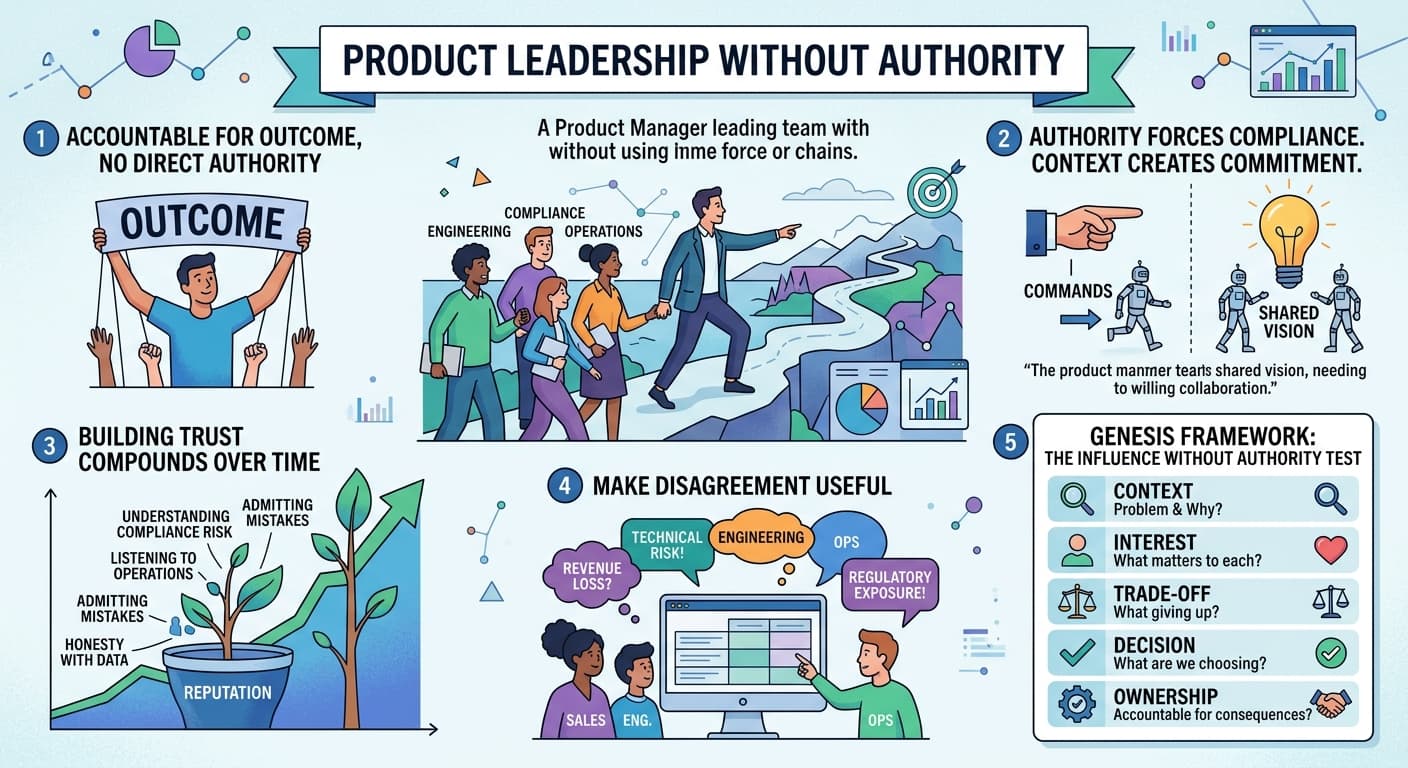
Authority can force compliance. Context creates commitment.
03 Trust compounds before you need it
You cannot manufacture influence in the meeting where you desperately need it.
It is accumulated earlier.
When you represent Engineering fairly in front of executives.
When you do not hide inconvenient evidence.
When you admit that a customer request is not as valuable as you first believed.
When Operations raises something ugly and you do not dismiss it because it complicates the roadmap.
When Compliance says no and you take the time to understand the underlying risk instead of immediately looking for a workaround.
Those moments build a reputation.
People gradually learn whether your judgment is about protecting your idea or protecting the outcome.
That difference matters later.
04 Make disagreement useful
A surprising amount of stakeholder management is wasted trying to eliminate disagreement.
I prefer to expose it.
If Engineering thinks the implementation is too risky, I want the risk named.
If Sales thinks delaying the feature will cost revenue, I want the revenue at stake quantified.
If Compliance thinks the control is insufficient, I want to understand the failure scenario.
The objective is not agreement.
It is a decision where the competing truths are visible.
Name: The Influence Without Authority Test
CONTEXT
Does everyone understand the actual problem?
INTEREST
What does each stakeholder genuinely care about?
TRADE-OFF
What does each option require us to give up?
DECISION
What are we actually choosing?
OWNERSHIP
Who is accountable for the consequence?
05 Leadership becomes visible when the answer is inconvenient
Anyone can “influence” when everyone already wants the same thing.
Leadership becomes visible when Sales wants one answer, Engineering wants another, the customer needs something else, and the organisation still has to move.
That is where product leadership earns its name.
You do not need everyone reporting to you.
You need enough clarity, credibility and trust that people are willing to move with you even when they would have chosen differently.
That is a much harder form of authority.
And often a more durable one.
Responses
Responses are reviewed before they appear.