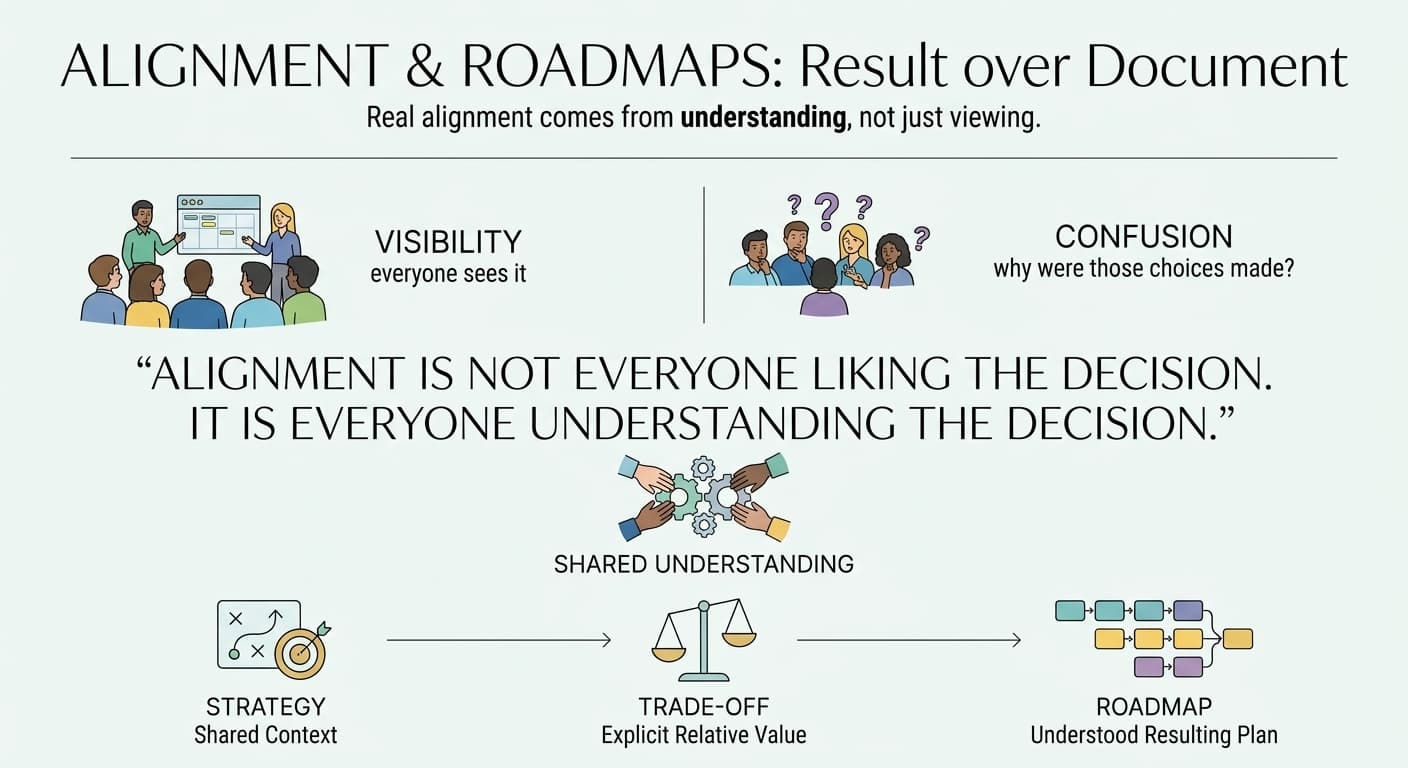
A roadmap can show what a team intends to do. It cannot resolve why different people want different things.
01 Roadmaps are often asked to solve the wrong problem
When organisations feel misaligned, the instinct is often:
“We need a clearer roadmap.”
Sometimes they do.
But many alignment problems are not information problems.
They are unresolved decision problems.
Sales wants an enterprise feature.
Operations wants reliability work.
Leadership wants growth.
Engineering wants technical debt addressed.
A beautifully formatted roadmap does not remove those competing priorities.
It only places them beside one another.
02 Visibility is not alignment
Everyone seeing the same roadmap is useful.
It is not the same as everyone understanding why those choices were made.
Real alignment requires clarity about:
what matters most,
what was deprioritised,
what evidence drove the choice,
what would change the decision,
and who owns the consequence.
Without that, the roadmap becomes a document people interpret through their own expectations.
03 Decisions need explicit trade-offs
“We are prioritising enterprise onboarding in Q2.”
That is information.
“We are prioritising enterprise onboarding over the planned referral programme because enterprise activation is currently the binding constraint on revenue expansion.”
That is a decision.
The second statement gives people something to challenge.
It exposes the trade-off.
That is healthy.
Alignment is not everyone liking the decision. It is everyone understanding the decision.
04 Roadmaps should be consequences of strategy
When the roadmap becomes the centre of product management, teams start optimising for roadmap stability.
That is backwards.
The roadmap should change when evidence, constraints or strategy change.
The important thing to protect is not the sequence of boxes.
It is the quality of the underlying decision.
Strategy → Constraints → Evidence → Decision → Trade-off → Roadmap → Delivery
05 The best roadmap conversation happens before the roadmap exists
Before discussing dates, ask:
What problem are we solving?
Why now?
What are we explicitly not doing?
What evidence would make us reverse this choice?
Who carries the consequence if we are wrong?
Once those questions are answered, putting initiatives on a timeline becomes much easier.
The roadmap is useful.
But it is not where alignment comes from.
Alignment is the residue of decisions that people understand.
Responses
Responses are reviewed before they appear.